Walking vs Driving – which is better?

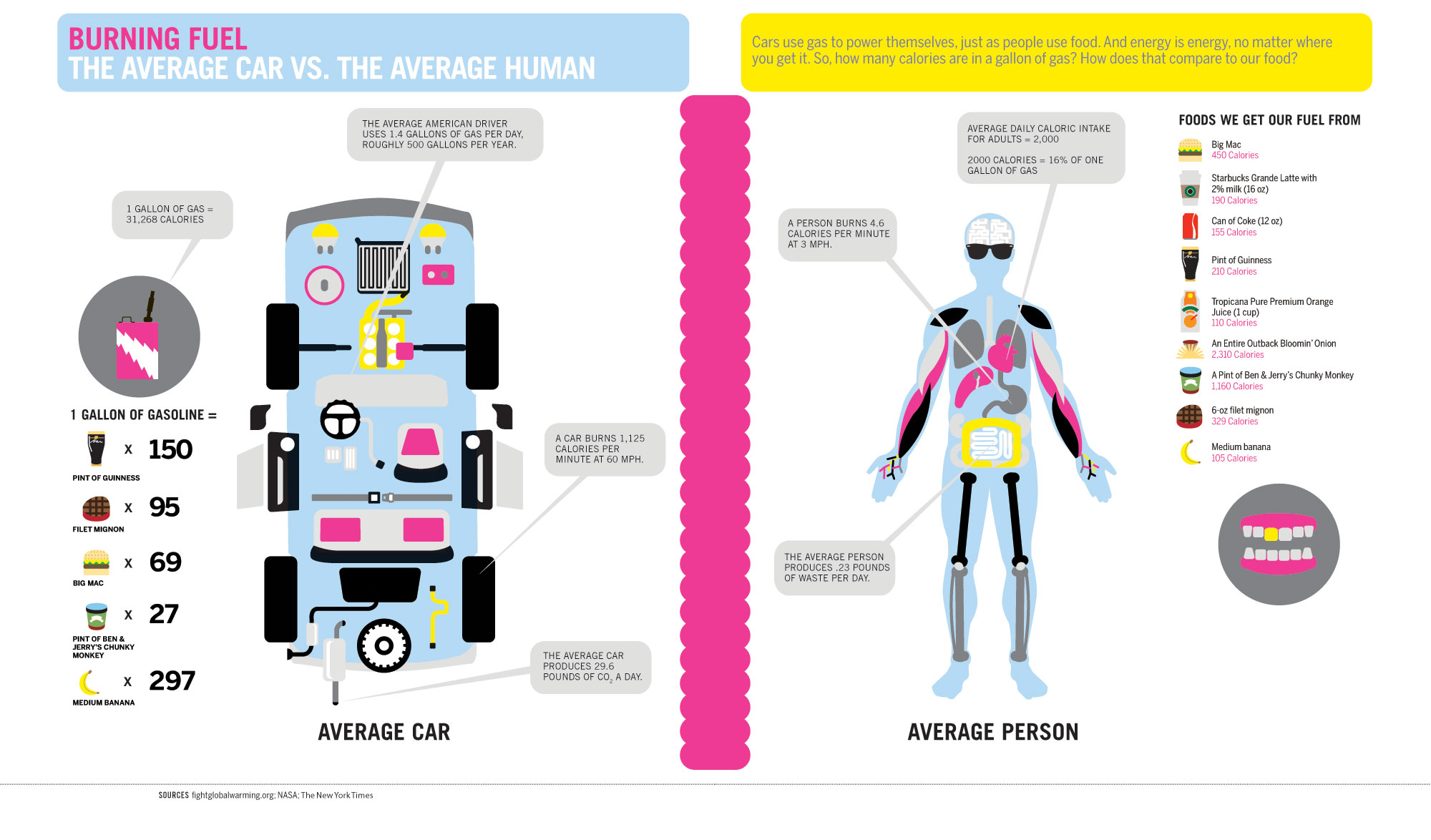
Who knew a pint of Ben & Jerry's has less calories than a gallon of gasoline?

A well done infographic is fabulous communication tool. Why? because it caters to the way the brain works. The infographic at right is a great example.

Before we dive into the details, let’s take a very short detour into the brain. Much has been made of the fact that brains are poor at dealing with complexity. Recently a new understanding has begun to emerge from neuroscience labs. In fact our brains have evolved some very clever techniques to work around this weakness. Our brains practice “chunking.” Chunking is both very descriptive of what our brains do and a sign that at least some scientists have a sense of humor.

Neuroscientists coined the term chunking to describe the way our brains process complexity. Instead of trying to track every fact the brain quickly associates the stream of incoming data with some existing high-level representation it already has stored. So you don’t have to recall each and every detail. All you recall is the chunk. And somehow when we recall the chunk we get all the detail associated with it. Nobody knows how, exactly.

The car vs human infographic juxtaposes two forms of transportation that couldn’t be more dissimilar: your car and your feet. But it does this with very simple forms, and lots of white space. Detail and density are the enemies when your brain is prepping for a good chunking. The graphic shows the energy content of the fuel of both vehicles, the burn rate at cruising speed, and the waste each transport system produces.

All this encourages you to explore the relationships. Cruising at 60 mph your car burns 1.125 calories a minute. At your body’s 4 mph cruising speed you burn about 5 calories per minute. It’s easy to imagine the implications. For instance the graphic shows that a car produces about 30 pounds of CO2 per day. The average car commute is 32 miles round trip. You  can walk that distance in 8 hours.   And depending on who’s counting, in a walk of that duration you will emit between 1 and 2 pounds of CO2.

So what this infographic does is put you into the optimal state for learning, known as a flow state. That is, a state where the balance of challenge,  concentration and skills are rewarded with insight.So you’re more likely to remember just how energy intensive driving your car really is.


The Power of Anchoring to Stop Innovation

Anchoring: sometimes the brain works in weird ways.

Would you consider a 50% death rate among your staff to be a serious problem? That’s typically how many sailors died on ocean voyages in the 1700s. Scurvy was the main killer, not enemy action. By 1747 a young Royal Navy surgeon found a scurvy cure. Yet 50 years passed before the Navy started adding a spritz of lime juice to the daily rum ration, to end scurvy. The story is a great example of how a mental process known as anchoring stops innovation in its tracks.

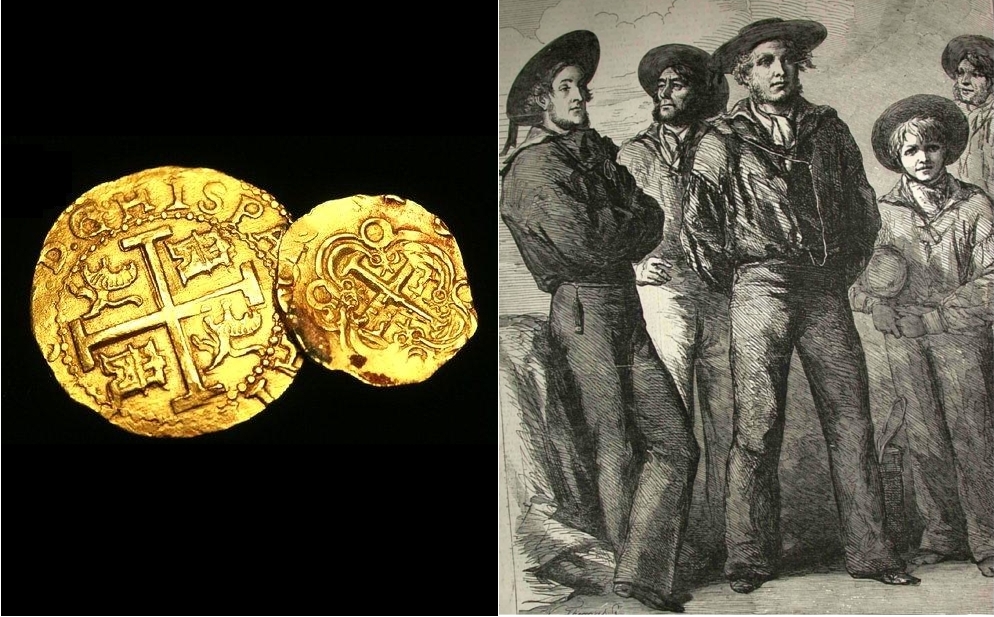
In 1740 Captain George Anson lead a squadron of 6 warships and 2 supply vessels on a round-the-world voyage in pursuit of a Spanish treasure ship. Of the 1,850 men who sailed only 180 men survived. That’s a 90% death rate. Scurvy is caused by not eating enough vitamin C. Your gums bleed, your teeth fall out, and then it gets nasty. The Navy brass were unsure of what caused scurvy but they knew it was crucially important to capture the treasure ship.

This is anchoring at work, the tendency of the brain to hunt for a reference point when it needs to make a decision. All facts are then evaluated relative to the reference point — NOT the absolute value of all the facts in total. Often the anchor is set early in the going, when you’re first learning about a subject. That is, you tend to give greater weight to things you learn first, and discount later facts.

Anchor #1: old ideas seem more important. For centuries people believed there was no difference in the food value of these two items.

So, back to Captain Anson and the Royal Navy brass. They were aware decades before Anson’s voyage that citrus juice seemed to prevent scurvy. And scurvy was known to kill far more sailors than enemy action. However the notion that nutrition had anything to do with scurvy was a completely foreign concept. For centuries all food was thought to be the same. As Bill Bryson wrote in At Home – A Short History of Private Life, “a pound of beef had the same value for the body as a pound of apples, or parsnips or anything else.” This was just one of the ancient and time-tested anchors that new ideas about scurvy prevention had to move.

The horrendous death rate of Anson’s crews was not unnoticed. It contributed to James Lind, a Royal Navy surgeon, testing out citrus juice as a scurvy cure in the late 1740s. On one voyage Lind divided 8 sailors with scurvy into 4 groups. He gave each group a different diet. Only one group got lemons and oranges. Only the sailors who got citrus juice recovered from scurvy. Pretty compelling proof right?

Wrong. Nothing happened. Despite Lind’s hard evidence, 50 years passed before the Royal Navy added lime juice to the regular diet of its sailors.

Anchor 2, mission priority. When you need 100 million or so of the items on the left, letting scurvy kill a few thousand or so of those items on the right seems like a good deal.

It wasn’t just that the Navy brass were especially stubborn. There was another anchor already set. England needed to finance an arms race with Spain. The threat of open war was constant. Spain held Central and South America. These territories were rich in gold and silver, far moreso than England’s colonies. Spain showed every sign of being able to outspend England. Then as now, arms races are terribly expensive. Lord Newcastle, the First Lord of the Admiralty, gave Anson one mission and one mission only. Steal as much Spanish treasure as he could, and get home. It was great strategy. It lessened Spain’s advantage and boosted England’s ability to keep pace in the arms race.

Capturing a treasure galleon was great strategy but fiendishly hard. In over 150 years of trying Anson’s capture was only the Royal Navy’s second success. Anson was given a hero’s welcome. Eventually the King made Anson First Lord of the Admiralty.

Worst seatmate, ever

I fly alot, yet never realized until today just how lucky I am. For I have never met Dr. Joy Reidenberg on a flight.

Dr Reidenberg dissects whales for a living. She loves her work. Which is why, unlike any sane person, she has crawled inside over 400 whale carcasses.

Dr. Reidenberg and an absent friend. Her fancy rubber suit doesn't help.

After a dissection she takes multiple showers and baths but still smells “like a refrigerator that has gone days without power.” She has a busy teaching schedule and can’t wait the several days needed for the stink of whale grease to evaporate from her skin. Goodness knows how I have never wound up seated beside her.

So I wish her well. And I hope she posts all her travel plans on TripIt. Whenever she’s travelling, I want to be on a different flight.

Viagara vs energy conservation

It pains me deeply that viagara spam often has a better success rate than energy conservation programs. Researchers have known for 30 years that the ways we motivate people to conserve energy often don’t work. But we keep at it the old way.

Here’s what we do. We carpet bomb people with facts about how much energy we waste and how much all that waste costs. Then we offer to pay them to behave better, to use energy efficiently.

Studies of the success of these programs show them to be hit or miss. Some programs are heavily used, some gather dust. Sometimes people permanently cut their energy use, alot. In others people still guzzle energy like there’s no tomorrow.

It seemed like a good idea at the time. With thanks to http://www.fark.com.

So I dug into the roots of the problem. Over the next little while I’m going to share what I found. It all starts, and stops, with how we think. We assume that people think rationally. We don’t.

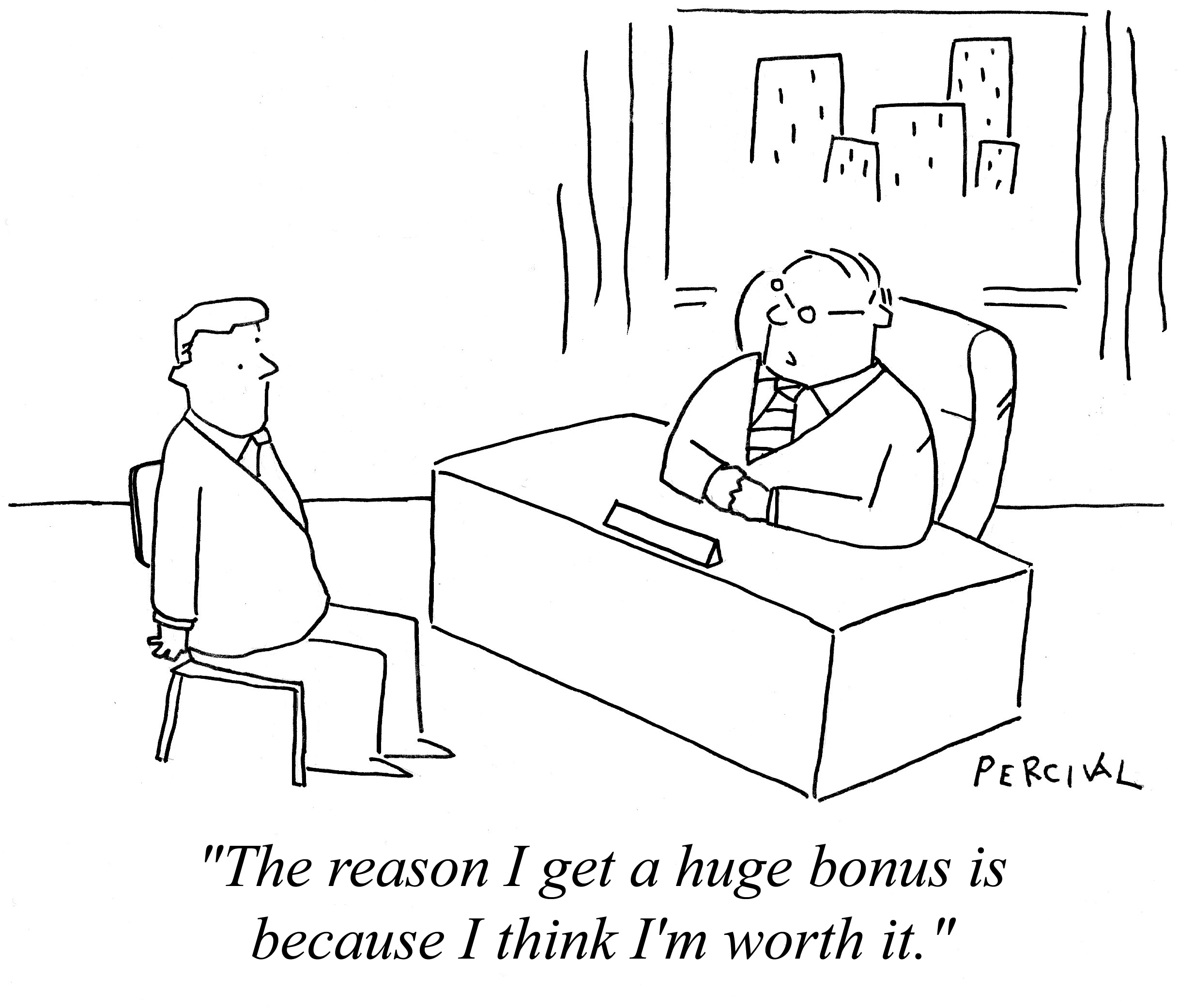
Big bonuses produce better performance, right?

Bigger bonus = smaller results. Huh?

Wrong. This is no left-wing spin – the research was funded by the Federal Reserve Bank.

When you pay people who have to think, the bigger the bonus you pay them, the smaller the results your get. Bigger bonuses only drive more results when you pay for work done by your people’s hands and arms, legs and feet.

So why are we laughing?

Don’t believe me? In fact, do you feel rather angry? Rant away. But if Vegas ran a book where you bet on the results of these experiments, and you put your money on the players offered the big bonus, the house wins. Come to think of it, the house does win in Vegas.

For a 10-minute visual picture of the perverse power of bonuses, check out Dan Pink’s talk Drive: the surprising truth about what motivates us. The infographic at top right is from Pink’s talk.

For detail, check out Dan Ariely’s The Upside of Irrationality. It’s fascinating.

More about Envy

No happy ending, unless there's another bone -- right now.

News from the social science lab shows how envy can improve response to rebate programs, or ruin them. Research shows that envy alters the way we think and act:

  • Memory and attention are stimulated by envy. That’s good.
  • Feelings of envy make you give up sooner on problem-solving tasks. That’s bad.

Those findings are reported in a recent New York Times article, A deadly sin that serves a higher purpose.

To exploit the good and dodge thebad we need rebate program structures that either:

  • shorten up the payback cycle
  • or maintain a steady trickle of rewards to keep you engaged until the big payoff arrives

Splinters of good news

The Global Carbon Project’s (GCP) 2010 report states that global CO2 emissions grew again in 2010 after stalling during the global financial crisis. Not good.

The longest journey beigns with a single step

But the news is not all bleak. For some time trees have been touted as a place to store CO2. Trees “eat” CO2 to grow.

The problem with trees is that we cut more than we plant. The shortfall is especially acute in the rain forests.

In 2010, that deficit became a positive for the first time. Here’s how Professor Corinne Le Quéré, of the University of East Anglia and an author of the GCP study describes it: “for the first time, forest expansion in temperate latitudes has overcompensated deforestation emissions and caused a small net sink of CO2 outside the tropics.”

In plain English: trees planted by the developed world sucked up enough C02 to make up for trees cut down in the rain forest. Plus a little bit more.

What power generation and sewage treatment have in common.

They're drinking sewage cocktails.

The struggle to get drought-parched citizens of the US southwest to drink sewage recycled into fresh water shows how conservation campaigns go wrong and how to fix them.

Take the greater San Diego area. It imports 90% of its water. It’s water sources are already drying up and drought is set to make the situation worse. Even knowing those facts, two attempts to win public support for programs to recycle sewage into drinking water have failed.

One of the few successes is El Paso TX, whose citizens are lapping up “toilet to tap.” 40% of its potable water is supplied from recycled sewage. El Paso’s public education campaign employs the “Mother Theresa” strategy.  That is, if you knew a mass murderer owned a very nice sweater you would still be creeped out by the thought of touching it. But if that sweater came into Mother Theresa’s hands before yours, and she wore it, you would want the sweater.

So, El Paso promised to pump its treated sewage into the ground. The water would percolate through underground rock and gravel before it enters the aquifer that feeds into El Paso’s fresh water system. Experts carped that the treated sewage might be dirtied in its passage to and through the aquifer. These appeals to reason failed to shake the public faith in the purity of nature.

Elsewhere, Singaporeans consume 3 million gallons a day of drinking water purified from sewage.

To win public support the government made it personal. Singapore, the campaign explained, had become dependent on uncertain foreign water supplies. This threatened national security and continued economic growth – the foundation of the wealth of each Singaporean.

Worst green marketing. Ever.

This video of the Chevy Volt dancers performing at the LA Auto Show is not for the faint of heart.

Personnas that work expose the feelings & emotions underlying rational thought

Lately I’ve been reading and thinking about the role of emotion in buying decisions. Then I read a review of the Chevy Volt.

The reviewer is one Mark Richardson, who edits the automotive section of my newspaper. He is not a Volt fan. Would the road test change his mind? Richardson devotes the first 15 paragraphs to how the Volt makes him feel. Here’s a taste:

  • “it doesn’t deserve the hype”
  • “it’s expensive”
  • “its claimed fuel consumption is a hopeless distortion of the facts”
  • “its won awards it doesn’t deserve… from sycophantic ‘auto journalists’ who’ve never even turned a proper wheel in it”
  • government rebates to buy plug-in cars are “a bribe.”

Pretty harsh, and typical of how the majority of consumers feel. Wave a green flag in front of them and you fan these hot coals of contempt into flame.

These views put Richardson in the heart of the Late Majority segment of car buyers. So total cost of ownership (TCO) should loom large in his thinking. Richardson writes 5 paragraphs to calculate the total cost of ownership. He’s excited when the Volt’s TCO is less than its all-gas sibling, the Cruze. But he’s still not convinced.

Like a Late Majority type Richardson demands performance too. Listen to how Richardson describes driving the Volt:

  • “There’s no compromise”
  • “It’s peppy if you want it to be.”
  • Recharging the battery during braking “is not so obvious that it’s a distraction”
  • Unlike all-electric cars, driving the Volt gave him no “range anxiety… you can drive the Volt as an electric commuter all week and then up to the cottage on weekends. If you forget to plug it in, no big deal.”
  • Richardson was “astonished at the unobtrusive capability” of the Volt

Did spending time in a Volt make Richardson change his mind? Yes. The Volt is his candidate for Car of the Year. Anybody who markets products with a green dimension needs a personna in their library based on Mark Richardson.