Why Can’t Canada Have A Facebook-Scale Going Public Event?

Big IPO valuations don’t sneak up on small companies.

The idea that any startup could IPO valued at a $100 billion was ludicrous, until Facebook. Several other IPOs and buyouts followed at similar eye-watering valuations. Skeptics, and I started out in this camp, see these events as symptoms of a dangerous bubble.

Then you hear Jos Schmitt, CEO of Aequitas, make a sound argument for Facebook’s extraordinary valuation.

Even more surprising, Schmitt makes a compelling case for why Canadian startups are chronically undervalued, and how to change that.

Schmitt was Michael Cayely’s guest for an April 14 2014, Startup Grind Toronto fireside chat. Once again Willdeboer Dellelce hosted in fine style. The Toronto-based law firm is a specialist in startups.

Schmitt has a unique perspective. His bio says “25 years of experience in the financial services industry with expertise in market infrastructure, across asset classes and across geographies.”

In concrete terms, Schmitt knows stocks, bonds, and other interest-paying investments. He has developed deep insight into why people trade them, how the trading markets work and what tools they use to do it – wherever in the world that people trade.

In June of 2013 Schmitt took on the role of CEO of Aequitas, a company dedicated to creating a new Canadian stock exchange. More importantly, Aequitas is creating a new platform for trading private securities focused on improving the liquidity of small- and mid-cap companies.

Ask Schmitt what holds back Canadian tech startups and he acknowledges the usual suspects. Talent-finance-revenue are indeed problems, well documented by IT Business Canada in its ongoing coverage of PWCs annual Report on Emerging Canadian Technology Companies.

But Schmitt sees a systemic root cause. “The ecosystem is not working well. It’s not a lack of smart people, good education or people with good ideas. We don’t lack capital in Canada. There’s a lot of it. It’s that it keeps going to other places and not into the world of entrepreneurs.”

Schmitt says there are two important gaps for small- and mid-cap companies. The gaps are in mentoring and liquidity.

“There is still a lack of mentorship, people helping entrepreneurs to find their way in a world which is quite complex. It’s great to be a champion in a certain area (of tech). But how do you fund it? How do you take it to market? How do you develop a distribution channel? How do you acquire clients? How do you manage a company? Lots of items of that type are still missing.”

Schmitt believes there are now a lot of initiatives to address the mentorship gap. Time and persistent execution should close the mentorship gap.

Lack of liquidity, says Schmitt, is still a problem. “There is an enormous funding gap as soon as you get above $2m to $3m. To look at companies in a simple way, you have starting it, building it and growing it. ‘Starting’ is when you define it. ‘Building’ is when you really develop your product and find your first clients. Once you get to ‘grow it’ there is no money in Canada.”

This stunts the growth of companies. That harms entrepreneurs and employees. Governments fail to get a decent return from their investments in education and early-stage tech company supports. It hurts the Canadian economy as a whole.

So, says Schmitt, entrepreneurs are faced with three alternatives. Many choose to “exit very early. Yes, you get a little bit of money out of it. But you miss the enormous opportunity to build a really great company. With all the opportunities it could represent for you as a founder and also for the entire economy in Canada and for employment.

“The second alternative is that people just go to the US and find an investor there. The ecosystem there is much better.” An extreme example is Facebook. Instead of jumping from Series B to IPO, Facebook traded on private markets, and maintained focus and control while building up its valuation.

“The third one (alternative) is that people go public far too early in their life cycle. You should still be focused on growing. Developing your business. Making sure your products are working well.”

When you go public too early, “suddenly you’re exposed to a world where you face quarterly results, enormous reporting needs.”

Companies pay penalties in both the short and long term. Publicly listed small- and mid-caps, says Schmitt, “are probably spending 20% – 30% of their time and cash (on reporting), which is enormous.” If such companies could trade on private markets these costs would plummet to just “a few percentage points.”

In the long term, “you are publicly traded and you don’t have that many investors who are that interested in you,” says Schmitt. “You become a company that trades 500,000 shares a week. No liquidity. No liquidity becomes an orphan company. You need funding afterwards, people will say ‘wait a minute – this is not a liquid company, I’m going to want a discount.’ ”

How does your experience compare with the picture painted by Jos Schmitt?

CTO’s Ambivalent Attitude To Tech Works Awfully Well

“It’s a little weird but I have an ambivalent attitude about tech.”

Deciding to build your cool new tech with immature tools can lead to problems.

Deciding to build your cool new tech with immature tools can lead to self-inflicted wounds.

This was one of several surprising insights from Bohdan Zabawskyj, serial startup CTO. He was Michael Cayley’s guest for a March 27 2014 Startup Grind Toronto fireside chat. Willdeboer Dellelce and Shopify – both startups once upon a time – sponsored.

Zabawskyj deflects praise. “I characterize myself as an entrepreneur helper, I’ve never made the leap and started a company on my own.” But his track record as serial CTO speaks for itself. He played a key role in shaping the success of Clearnet, Rypple and Redknee. He’s at it again with Mercatus. And he still finds time to advise half a dozen more startups.

So how does Zabawskyj employ his tech ambivalence? In his experience, a high level of risk is inherent in a startup. So, “if you’re trying something new, stay away from the bleeding edge.”

Startups need to build, test and iterate on the core value generator ideas as fast and often as possible. It’s an inherently high-risk activity. Why add to the risk by using new development tools? It makes finding talent, which is already hard, much harder. Mature software development tools come with much larger communities of experienced developers startups can draw on.

“I’ve never seen perfect technology, architecture or code,” says Zabawskyj. “Chances are you’ll re-code half a dozen times before you achieve product-market fit.” It’s key insight into how he manages the tension within the Agile methodology. Re-writing code to improve functionality or boost performance is not waste. It’s refactoring.

Another lesson Zabawskyj learned in the startup grind is deep respect for soft skills. “I often think the ‘T’ in CTO stands for ‘therapy.’ A lot of it (the CTO role) is human and process issues. How to find people and build culture.”

Zabawskyj warned Startup Grind-ers to build their plan around the strengths of their people, and to protect them from their weaknesses. For example, there’s one of the biggest headaches of software development: scheduling. Even among the best coders, their ability to predict how long it will take is limited. “Human estimation falls apart after two to three days,” says Zabawskyj.

In a follow up interview I asked Zabawskyj to reflect on his career in light of the Fraser Institute’s recent proposal to replace lost Ontario manufacturing jobs with resource extraction jobs.

The Huffington Post challenged the Institute’s claim that that solution is “to unleash [Ontario’s] private sector on its northern resource frontier.” The Post notes that 5,100 jobs might be created by one of the Ring of Fire mining projects 500 km northeast of Thunder Bay. And those jobs are “two per cent of the 255,000 jobs lost in Ontario manufacturing in the decade between 2002 and 2012.”

Because tech tends to create more employment and value from less capital, Zabawskyj sees tech as a better job creating strategy.

He said that when Salesforce.com bought Rypple it was valued at about $60 million. That’s more than four times the $14 million in capital invested by Angels and VCs.

At a capital cost of $2.25 billion for the Ring of Fire chromite mining project, each job it creates will need $440,000 of capital. That, Zabawskyj notes, “is a pretty big angel investment round for a startup”.

“Look at Redknee. It was started with a $70,000 investment by the four founders. It’s now valued at north of $500 million and employed 500 people worldwide when I left in 2010, half of those in Canada.”

The value tends to stay in Canada. Even when Canadian tech companies are acquired, the jobs tend to stay here. So do the taxes paid by these employees. The main market for the chromite mined in the Ring of Fire is Chinese steel mills.

And tech is creating far more opportunity than existed when Zabawskyj was a newly-graduated engineer just a few decades ago. “Back then the only choices available were telecom, manufacturing and resources. If you wanted to do something interesting you had to leave. That’s not the case anymore.”

Big Data Needs Designers Not Technologists

Yet another example of why design is as important as data.

Yet another example of why design is as important as data.

“Data can give you an uplift or a depression, but the fundamental trajectory is not set by data. Design is the most important function.” That was the surprising message delivered by Google Ventures’ Anish Acharya to a packed StartupGrind Toronto gathering in September of 2013.

Acharya knows whereof he speaks. He and co-founder Jeson Patel launched and built the successful social gaming company Social Deck, then sold it to Google. Acharya was drafted to be the product manager for Google+ and saw it through launch. He is now a Google Ventures partner.

Roger Ehrenberg of IA Ventures also noted the urgent need for design excellence, in a recent ITBusiness article on the flow of investment into big data startups. “What I see, especially in this space, it tends to draw brainy people but [it’s] not necessarily the most people-oriented, so entrepreneurs develop something cool that not that many people want… a tech founder also has to be a product manager.”

Despite Google Venture’s big-data DNA, Acharya says the focus of its investments is actually on “companies that have a culture and a rigor around data that is thoughtful, not on data per se.

“The interesting opportunities in big data are not in the capture of it – there’s some in management –but the interpretation of it. Making sure that every stakeholder and every decision maker who needs to see the data does, and what it means.”

Our attitudes about data may need to change. “We grew up in a system that emphasized Calculus over statistics. Calculus is closed solutions and statistics is probabilistic” says Acharya. “That’s one of the reasons many of us had to spend some time understanding statistics… As a business community we’re getting better at that.”

On the practical level, Acharya says the challenges facing companies outside the Valley often come down to product leadership and community. He’s in a position to know. Social Deck was based in Toronto but he and Patel invested a lot of time cultivating the Valley VC community.

“It’s tough to find the maturity of product leadership in Toronto, on the consumer product side in particular,” says Acharya. “You need to invest in mindshare presence in the Valley. They have a culture where they constantly interact with each other.”

That said, Acharya notes “the tactics we used in the App Store to drive distribution are not geography specific. So there’s no reason a company from Toronto can’t be a break out in any of these segments.

The next Startup Grind Toronto Fireside Chat is with Jos Schmitt, CEO of Aequitas on April 14, 2014.

This is a guest post by Geoff Foulds, CMO of AffiniD, a startup based in Toronto and San Mateo.

Do Agile, Toyota Production Method and Lean Construction Go Together?

What do agile, Toyota Production Management and construction have in common? Everything. The story is told by Mary Poppendieck in her talk, The Tyranny of the Plan. A big, big thank you to Chris Gagne for transcribing the talk.

From Hardware to Software and Back Again

Why does a coder have anything useful to say about construction? Years ago Japanese companies started selling videotape in the U.S. below the cost of American vendors. One of those vendors was 3M. It set up a team to learn how the Japanese did it. 3M made Poppendieck, one of its process control programmers, part of the team. This was long before Lean. All 3M’s team could find was a terrible translation of Taiichi Ohno’s book. Without options or time, 3M had no choice but to give Ohno’s ideas a try.

3M’s US plant began to beat Japanese videotape vendors on price and quality.

Poppendieck continued to explore the convergence of Toyota Production Method and code development. She coined the term lean software development in a book by the same name, published in 2003.

The Problem: On-time-and-budget Delivery

Mary coaches software developers on Lean and Agile and she noticed a disturbing trend. Project management tools were more sophisticated than ever. But on-time-and-budget delivery seemed to be less and less predictable.

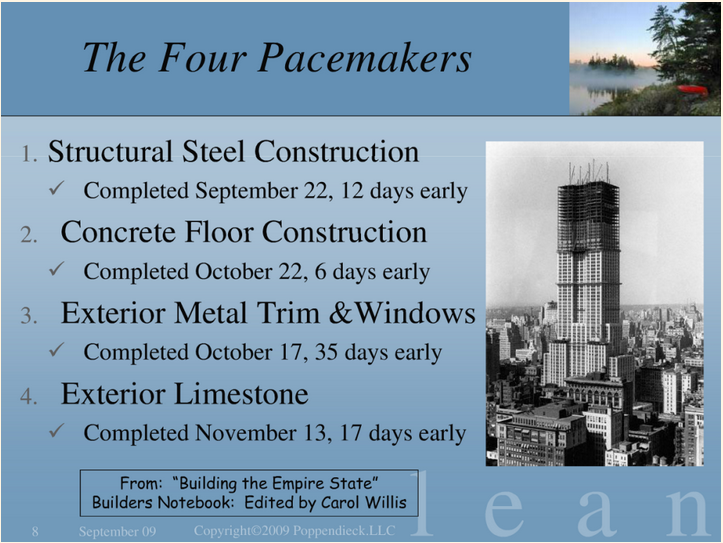
The cadence of pacemaker tasks dictates the project's pace.

The cadence of pacemaker tasks dictates the project’s pace.

So Poppendieck looked at old-school project management. That is, the era before computers. She discovered that builders used to be the masters of delivery.

In the 1920s New York general contractors put up 60- and 70-floor buildings in 12-18 months as a matter of routine. Starrett Brothers and Ekene designed and built the Empire State Building in 18 months. Between September 1929 and April 1931, 102 floors were erected. Tenants began moving in during May 1931.

Because of the Crash of 1929 and World War 2 the Empire State Building was the last skyscraper built in New York for nearly 20 years. The knowledge died out due to old age and war.

Today many believe that government red tape prevents us from matching the pace of the 1920s. Poppendieck found that today’s labor laws are modeled on the best practices of the 1920s-era skyscraper projects. Those buildings are still sound today. So builders didn’t skimp on materials or workmanship to speed up work.

Lost Secrets Found Again

The secret  was rediscovered when the lost project notebooks of the general contractor on the Empire State Building were found a few years ago.

Based on decades of doing and learning the builders discovered that “pacemaker tasks” controlled entire projects. For the Empire State Building the tasks were:

  1. Structural steel
  2. Concrete floors
  3. Windows and trim
  4. Cladding

How these tasks are managed is critical. One key is for work crews on these pacesetter tasks to maintain a steady cadence. Another key is to decouple the pacesetter tasks from each other. These two insights helped the builders to eliminate cascading delays.

This is what Ohno means when he writes about Flow. It is the secret of the Toyota Production Method and it’s been hiding in plain sight.

Many still think Lean is about waste. But waste is only a symptom of disrupted Flow. You can eliminate waste and it will pop up again and again until you fix whatever obstructs Flow.

The Magic of Goal, Deadline and Budget

Poppendieck noticed another important difference between then and now.

Today we follow a design-budget-build sequence. Delivery date is a byproduct.

Back then, New York builders used deadline, budget and total number of floors as the driving factors. Design was the byproduct of these constraints.

Enjoy.

Buying Personas – Something Old, Something New

Jay Baer’s  Youtility is a fun read. He says that “smart marketing is about help not hype.” It’s a bit shocking that this statement still has the power to shock.

Image

Buying personas then and and now

Baer points out that organizations are 60% of the way through the sales process before they call a sales rep. The stat was generated by the Marketing Leadership Council (MLC). It surveyed 1,900 organizations, private sector and government, enterprise and medium size and manufacturing, tech and finance.

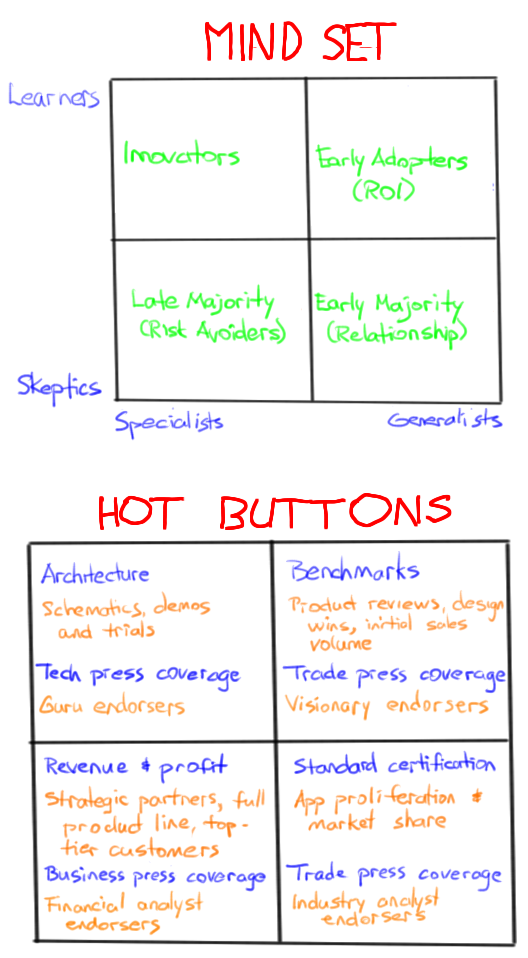
MLC also “discovered” four distinct buying cultures: the Innovator, the ROI guy, the Relationship-er and the Risk Avoider. Those four buying cultures reminded me of Geoffrey Moore’s Innovators, Early Adopters, Early Majority and Late Majority.

I’m having to hypothesize because MLC hides its details behind a paywall. A bit ironic given that Baer’s message is “customers prefer to self-educate themselves — you win by making it easier for them.”

I’ve mapped Moore’s segment personnas into a 2 x 2 matrix to show what I mean.

The dominant feature of Moore’s Late Majority is that they’re skeptics. They need ALL the boxes ticked. Change is danger so they delay change as long as possible. Do these people sound like Risk Avoiders?

Moore’s Early Majority need to be comfortable that others in the community are making the move. Does it seem that these peoples’ defining characteristic is Relationship?

Moore’s Early Adopters are all about benchmarks and tangible improvements that are measured. Sounds like MLC’s ROI Guy to me.

Moore’s Innovators are all about speeds and feeds, ease of use, design elegance, and unique functions. This has been the standard candle for innovators for 20 years. It seems likely MLC is thinking along these lines for its Innovators.

In my experience multiples of these personnas are in play at the same time. You seldom get just one. Watch several of the customer testimonials on the OPower web site. Every spokesperson touches on at least two of the themes, often three, and sometimes all four.

This deeper emotional underpinning, what they’re feeling, is what will really hit home when you capture it in your marcom. Customers’ words are the key. Their testimony in their own voices is far more powerful than your best paraphrase. The maximum power is in the body language, intonation, repetition and other non-verbal cues. A good writer can capture this essence in words alone. If you can get video, so much the better.

The Two Most Important Numbers for Startups

First, there’s 60%. Enterprise customers are 60% of the way through the purchasing decision process by the time they call a rep. That’s what the Marketing Leadership Council (MLC) found in a survey of 1,900 of your targets.

Does your business plan depends on sales wins with enterprise customers? Then their ability to use the internet to educate themselves makes your task tougher. Because a smarter customer devalues what your reps know about products and solutions. So reps have less to trade for customers’ “why” and “who” information. That is, the decision making criteria, customer culture, internal politics, and key people.

Then there’s 80%. In surveys 80% of customers – and more — say that reps are unprepared for the first call. That shows the impact of customers educating themselves.

Here are four suggestions to re-balance the conversation with enterprise customers.

  1. Get the (right) word out. Suppliers who provide better information online get more business. The “right” words show how people use your stuff, and why.
  2. Create conversations. Write more testimonials, less white papers. Take a leading role in the special interest groups related to what you do.
  3. Message all buying personas. Learn to listen for the voices of the Innovator, the ROI Guy, the Relationship-er and the Risk Avoider. Usually all of them are in play so all need to be messaged.
  4. Tell a whole product solution story. Most products or services are part of a larger solution so providing the context adds value. Develop an example solution to present at webinars and trade shows. Keep practicing and polishing it.

What it takes to change the world

Were it not for John Hinckley and his crazed passion for a Hollywood child star, climate change would be far more advanced. Don’t believe me? Read on.

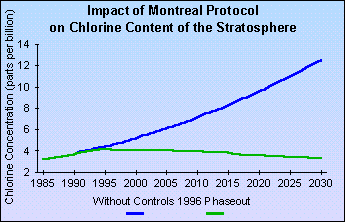
What might have been, in blue; what is, in green.

What might have been, in blue; what is, in green.

In the early 1970s, years before Hinckley fired on Reagan, chemists hypothesized that the widespread use of CFCs for refrigeration and spray bottle propellant might lead to much higher rates of deadly skin cancers.

Ozone gas high in the stratosphere normally absorbs most of the sun’s ultraviolet-B rays. What UV-B does get through is enough to cause skin cancers. CFCs are harmless at ground level. But they float up to the stratosphere where UV rays break the CFCs down, releasing high concentrations of chlorine atoms. A single chlorine atom can destroy 100,000 ozone molecules. And we were releasing nearly 1 million tons of CFCs a year. A skin cancer epidemic was highly probably without a ban on CFCs.

The 1987 treaty that banned CFCs took years to negotiate and was strongly opposed by many in the UK, France and Germany.

One of those opponents was Ronald Reagan. He won the presidency in 1980 on a platform of deregulation. Important Reagan appointees questioned CFC science. Anne Gorsuch, head of the EPA (Environmental Protection Agency), challenged the link between CFCs, stratospheric ozone depletion, and skin cancer epidemics.

But by 1986 Reagan was quietly supporting an aggressive global ban on CFCs according to Andrew Benedick, the lead US negotiator. Why did Reagan act against his principles?

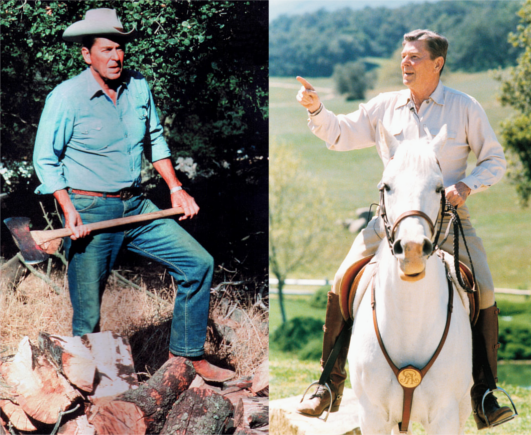
No more for you, Mr. President.

No more for you, Mr. President.

Benedick and others credit Reagan’s fight with skin cancer. Reagan loved the outdoors. Whenever possible he would sneak away from the office to ride his horses and chop wood. In early 1985 the bill for Reagan’s decades of unsafe sunning came due when doctors diagnosed aggressive skin cancer. To get rid of it doctors operated two, possibly three times, between November 1985 and July 1987.

But there had to be more. It can be hard to change your mind. But to change policy you have to resist the social pressure of your entire community – and win. Reagan faced strong opposition to the CFC ban from his own cabinet as well as the Republican party. Reagan’s support for a ban on CFCs makes him the only GOP president or candidate in over 30 years to defy the party line.

Some argue that Margaret Thatcher, a trained chemist, persuaded Reagan. But Thatcher only joined the ban-CFC bandwagon in late 1987 after the initial treaty was signed in July. Benedick says Thatcher came around after scientists, who had been denied direct access, were allowed to pitch Thatcher directly.

If not for this moment, climate change would be much worse now.

If not for this moment, climate change would be much worse now.

The appearance of the ozone hole likely played a part.

Scientists predicted that ozone levels would gradually decline. Instead a huge ozone hole formed in the skies over Antarctica in the space of a few years. It was obvious that the same collapse would soon happen in northern latitudes. This news became public in 1985 around the time Reagan’s dermatologist was giving him the bad news.

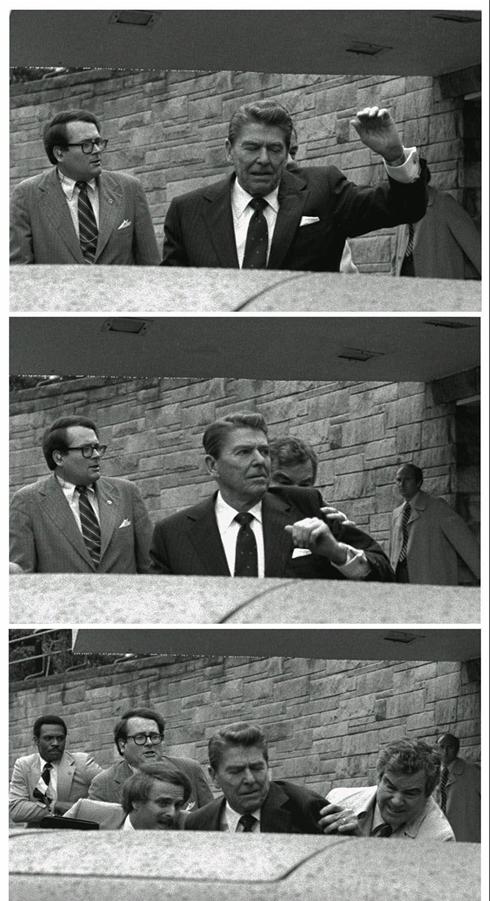
Before any of that, there was Hinckley. He missed assassinating Reagan in 1981 by the tiniest of margins.

Aid Michael Deaver told interviewer Charlie Rose that after the attempt on Reagan’s life he became more stubborn. He believed that he was chosen by a higher power, and that the shooting was a reminder of this. Reagan decided to more closely follow his own instincts.

As bad as the droughts, famine and flooding are today it could be much worse. CFCs are a very much more potent greenhouse gas than carbon dioxide. Without a CFC ban the effects of climate change would be far more advanced.

But thanks to a love of the outdoors, skin cancer, the ozone hole — and Hinckley — we have a ban on CFCs.

New Insight Into Why Fact Based Green Policy & Marketing Fails

Mr Emotion beats Mr Reason

McCoy is in charge, not Spock.

Can science explain why educated and intelligent people don’t believe science? Yes. For green marketing and green policy the implications are profound.

Since the Enlightenment we believed that people are rational. Give people the facts and based on reason and logic they will make sensible decisions. Research reveals an inconvenient truth that turns 300 years of accepted wisdom on its head. Facts take the back seat when we make up our minds.

  • Facts are filtered through values and beliefs, about morality and how society should be ordered
  • Education plus strong beliefs can make people more resistant to ideas that contradict their beliefs
  • When these conditions exist, attempting to motivate these people with facts can produce a backlash
  • Who you will accept as a legitimate scientific authority is determined by your value-belief framework.
  • It makes you discount the validity of facts scientists present about risks and benefits
  • These are universal human traits that show up across the spectrum of morals and beliefs

When it comes to climate change, and policies related to it, people with strong faith and conservative convictions are the most likely to deny the facts. When these folks are highly educated they actively attack the science  and policies related to it.

Is there any hope for change? Yes. The science must be presented by business or religious leaders. And the science must be framed in the context of business profit-and-loss, or faith-based values.

For more on the research behind these findings check out The Science of Why We Don’t Believe in Science in Mother Jones.

A new approach for selling green buildings and green retrofits

This doesn't look like green building. But his story will help sell them.

This doesn’t look like green building. But his story will help sell them.

Green buildings make their occupants happier and more profitable and are worth more. How come every new building isn’t green? How come every existing building isn’t getting a green retrofit?

The message isn’t getting through because of the way our brains process information. To summarize:

  • Thinking requires a lot of oxygen and calories.
  • To prevent exhaustion the brain filters out most incoming data.
  • Most is routed to the subconscious and processed there.
  • Conscious thinking is only engaged on exceptional things.

So how do we overcome our own defenses? Here’s a 3-step solution.

  1. Reframe the story.
  2. Find a respected community leader to re-tell the story
  3. Repeat, repeat, repeat

Let me give a simple example based on my own experience. I’m a skier and follow downhill ski racing. For a long time I only cared about who finished 1st, 2nd or 3rd. Then I changed my mind. Here is how it happened.

Reframe the story. I read a book by a retired racer. He explained that the difference between 1st and 15th is less than a tenth of second. That’s time it takes to blink 2 or 3 times. That’s incredibly close after racing 3.5 kilometers (2.5 miles) at 150 km/h (92 mph). Reframing showed that my focus on 1st, 2nd and 3rd made no sense.

Messages need messengers. The person who explained this was himself a world champion. At the time he was the first non-European ever to win the downhill championship. Plus he’s Canadian, as am I. All this credibility and personal identification has been proven to help new facts slip past the old guard.

Repeat, repeat, repeat. We are bombarded with more information than any creature that has ever existed in the 4 billion years that earth has circled the sun. This racer likely said these  things before and I follow racing news. But I only came across the story after he retired and wrote an autobiography.

Paris apartment block retrofit has it all: bigger, brighter, cheaper, unhappier. Huh?

Great story in today’s New York Times about a Paris public housing apartment block that gets a fabulous makeover – and some tenants are unhappy.

Yes, you can have it all.

  • Units are transformed into larger, light-filled spaces
  • The tenants lived in their apartments throughout
  • No increase in the building footprint
  • Energy use is now 60% less
  • The retrofit cost 42% less than demolishing and rebuilding – even though the makeover included extra elevators, upgraded services, and a lobby makeover

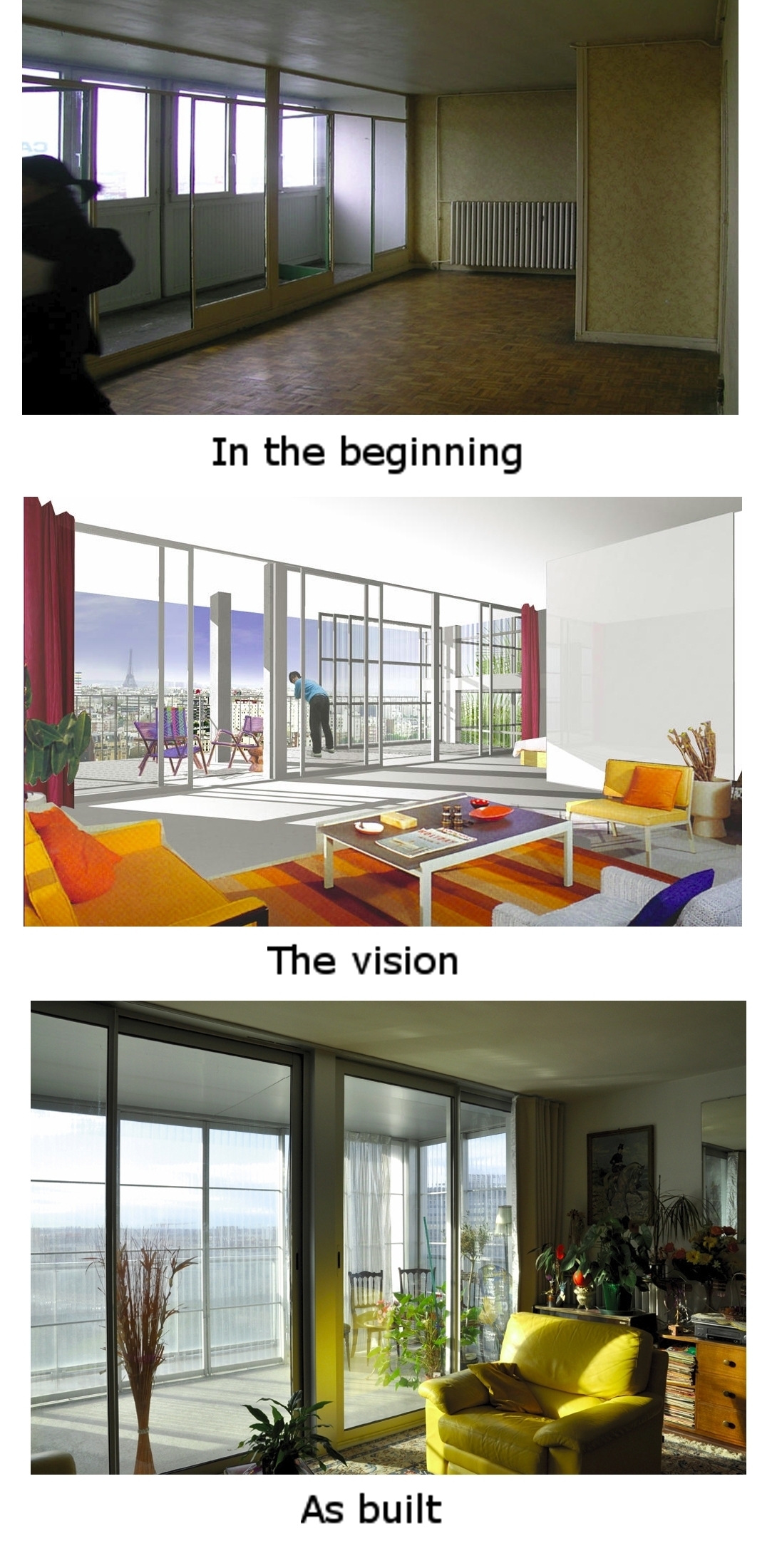
Lacation and Vassal architects delivered a brilliant solution. The NYT article describes how the architects added floor space and floor-to-ceiling windows  “using pre-fab modules erected like scaffolding on the outside” of the building. Have a look at the before-concept-after images. Stunning is not too strong a word to describe the transformation.

The pre-fab approach kept renovation costs well below those of demolition and rebuilding. Pre-fab was also the key to the tenants remaining in residence throughout renovation. The NYT notes that “punching through the old facade to connect these modules to the apartments (took) only one day per apartment.”

Despite all this good news some tenants are less than delighted. Complaints range from more noise in the halls to loss of gardening space. Is this simply ungratefulness? No. It’s a great example of how people make decisions based on emotions, then use their reason to justify the decision.

Here’s what I mean. Kids playing in the halls are making the noise. Kids didn’t play in the halls before the renovation. Then, the halls were too dark to be safe. After the renovation the halls are bright, pleasant spaces. And parents are letting their kids play in the halls. Can’t they control their children? As a parent myself, at times I have things to do where I need the kids out from underfoot. At the same time I want the kids close enough that I can keep an eye and an ear on them. I don’t want to be a bad neighbor but the safety of my kids comes first. From this perspective it is inevitable that the halls would get noisier.

With this in mind, could the budget have covered sound proofing for hall walls, floors, ceilings and doors?

The gardener is not grumpy; she is mourning the loss of her old gardening place and the vegetables it grew. Can you mourn for a garden? In this case, yes. The Times reporter notes that the gardener is a nun. Given the poor lighting and the poor pay of nuns it’s possible that she exercised considerable ingenuity and thrift to grow veggies in the old apartment. The self sufficiency might have seemed minor to others but likely meant a very great deal to her. If none of her old tricks and tools worked in the bright, spacious new apartment she would have to throw away all she had and start again. In the grand scheme of things, not a lot of money. But for her, heart breaking.

With this in mind, could a tiny fraction of the energy savings be set aside to help tenants replace their gardening tools?

This is no way meant to criticize the design work. It’s fantastic. It’s meant to shine some light on how important it is in the design phase to tease out how people feel .