This video of the Chevy Volt dancers performing at the LA Auto Show is not for the faint of heart.
Personnas that work expose the feelings & emotions underlying rational thought
June 25, 2011 — Geoff FouldsLately I’ve been reading and thinking about the role of emotion in buying decisions. Then I read a review of the Chevy Volt.
The reviewer is one Mark Richardson, who edits the automotive section of my newspaper. He is not a Volt fan. Would the road test change his mind? Richardson devotes the first 15 paragraphs to how the Volt makes him feel. Here’s a taste:
- “it doesn’t deserve the hype”
- “it’s expensive”
- “its claimed fuel consumption is a hopeless distortion of the facts”
- “its won awards it doesn’t deserve… from sycophantic ‘auto journalists’ who’ve never even turned a proper wheel in it”
- government rebates to buy plug-in cars are “a bribe.”
Pretty harsh, and typical of how the majority of consumers feel. Wave a green flag in front of them and you fan these hot coals of contempt into flame.
These views put Richardson in the heart of the Late Majority segment of car buyers. So total cost of ownership (TCO) should loom large in his thinking. Richardson writes 5 paragraphs to calculate the total cost of ownership. He’s excited when the Volt’s TCO is less than its all-gas sibling, the Cruze. But he’s still not convinced.
Like a Late Majority type Richardson demands performance too. Listen to how Richardson describes driving the Volt:
- “There’s no compromise”
- “It’s peppy if you want it to be.”
- Recharging the battery during braking “is not so obvious that it’s a distraction”
- Unlike all-electric cars, driving the Volt gave him no “range anxiety… you can drive the Volt as an electric commuter all week and then up to the cottage on weekends. If you forget to plug it in, no big deal.”
- Richardson was “astonished at the unobtrusive capability” of the Volt
Did spending time in a Volt make Richardson change his mind? Yes. The Volt is his candidate for Car of the Year. Anybody who markets products with a green dimension needs a personna in their library based on Mark Richardson.
Guns, ammo and energy rebates
June 3, 2011 — Geoff FouldsIt seems that when we give people feedback on just about any task, from ranging anti-aircraft artillery to reducing household energy use, our performance improves.
Perhaps the biggest surprise is that this fact is a surprise. 2011 is the 30th anniversary of a study that proves we conserve more energy if we get feedback on how much energy we’re using. It’s all there in Encouraging Residential Energy Conservation Through Feedback.
The authors of this paper wondered if feedback that compared homeowners to other, similar homeowners would be as effective. Thirty years on, the answer is “yes.”

Envy can do good. Really.
The reasons for that are well, irrational. It turns out that we make decisions based on emotion. All those theories about people as rational actors in the marketplace? Wrong. How we feel makes us skew the value of a fact compared to its absolute value. If reading this makes you angry, don’t worry. Your reaction is normal. When people are shown that their emotions make them play fast and loose with the facts they get upset.
Anyway, if you’re still with me, envy is that hollow, gnawing-in-the-gut feeling we get when our neighbor brings home a shiny new car, or a barbeque, or a baby.
It seems that when we find out we’re using more energy than our our neighbors we cut back to use just a little less than they do. Is that envy at work? Maybe it’s some inverted, dark envy? Who cares? It works.
So, to boost participation in energy-saving rebate programs let folks know how their household energy use compares to the neighbors’.
Green irony
March 29, 2011 — Geoff Foulds
Somehow the preview of Kingship’s new “eco-friendly” yacht sounds like the copy writer’s tongue was planted firmly in cheek.

50m, 500-ton eco-yacht, meet 20m, 34-ton brontosaurus. The blue biped is a human, to scale.
Here’s a taste of Green Voyager: “designed for the owner who seeks a low-impact vessel to cruise the globe; an owner who wants to cruise responsibly, but doesn’t want to compromise on luxury and comfort… the first yacht in the world under 164 feet (50 meters) built to Green Plus standards. She will be less than 500 gross tons.” Among the green features is a 16% improvement in propulsion efficiency and a zero-discharge sewage system.
Leaving one to suppose that non-eco-friendly yacht toilets dump straight into Davey Jones locker.
Kingship entered Green Yoyager in the Union Internationale Motonautique 2010 environmental awards. In its press release Kingship copywriters sound new depths of irony, stating that Green Voyager aligns with “UIM’s desire for ‘positive and proven actions which lead to a smaller environmental footprint’.”
Follow the money, again
February 27, 2011 — Geoff FouldsA recent installment of New York Times’ series on How to Make Your Business Greener is a reminder that sustainability is its own worst enemy. The Times profiles a small, family-owned tortilla producer and the story lead says it all.
While Joe Santana does not presume to understand all of the latest climate science, he has his own opinions about global warming. But as head of operations at Mi Rancho, a family-owned tortilla producer in San Leandro, Calif., he understands the importance of saving money.
After attending a series of workshops on sustainable business practices, Mr. Santana recently put into action a number of energy-efficiency and waste-reduction measures that he estimates will save Mi Rancho about $100,000 a year and pay for themselves well within the first year. “And if that’s good for the planet,” he said, “all the better.”
All good, right? Wrong. 50% of readers won’t go near the story because of its headline. It says: How to Make Your Business Greener. Even though the story is in the business section the headline is a complete turnoff for the 50% of the population who don’t care about the environment.
The same goes for the workshops where Santana learned how to save money, er green the planet. The workshop as about sustainable business practices. That concept is a turn off for the 50% who are motivated most by making money. Imagine the response if these workshops are promoted as opportunities to add 100s of thousands of dollars to your bottom line with zero risk.
The shortest route to a greener world is to focus on how much more money you will make.
Follow the money.
December 17, 2010 — Geoff FouldsConsider these factoids about the bottom-line benefits of green retrofits in the November-December issue of Distributed Energy Journal’s online edition:
- In just 3 years the entire $550 million cost of renovating the Empire State Building will be repaid from energy savings.
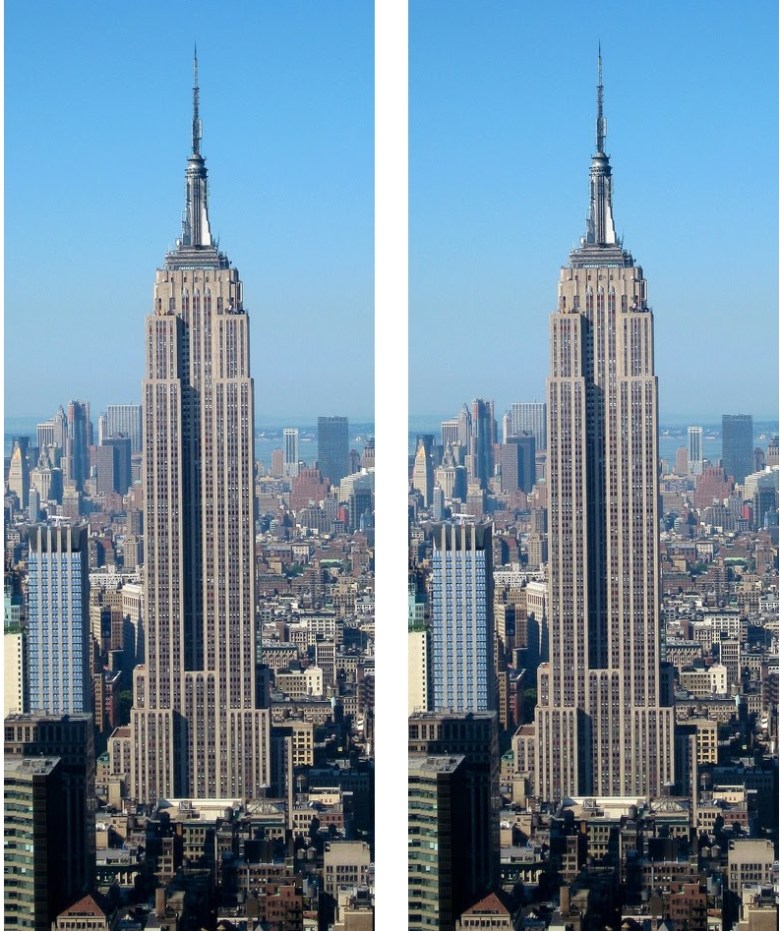
The old Empire State Building is on left. New one is on the right. Can you tell the difference?
- After the renovations pay off, the Empire State Building will continue to save energy costs to the tune of $4 million a year. And when energy prices go up, savings will increase.
- Every $100,000 you spend to reduce an energy bill increases the value of the building when you sell it by 10 times. That is the experience of the State of New Jersey’s Commercial & Industrial Clean Energy Programs.
- In a study by the CoStar Group tenants reported 30% fewer sick days for employees.
- CoStar researchers also found that building owners report shorter lease signings and higher occupancy than comparable buildings and rents that ranked above industry averages.
Spending money on energy savings is a no-brainer.
Selling green? Sell savings instead.
December 9, 2010 — Geoff FouldsA new study confirms that saving money is a much more compelling way to sell the majority of the market on green.
McGraw Hill Construction surveyed a total of almost 500 US architects, engineers and contractors in the building industry on their attitudes toward Building Information Modeling (BIM). BIM software enables architects and engineers to simulate the in-use performance of buildings they are designing. And BIM helps contractors ensure that design intent is carried through to the finished building, while reducing waste during the build phase.
The report identified two groups within the sample: “Green BIM” and “Non-Green BIM” practitioners.
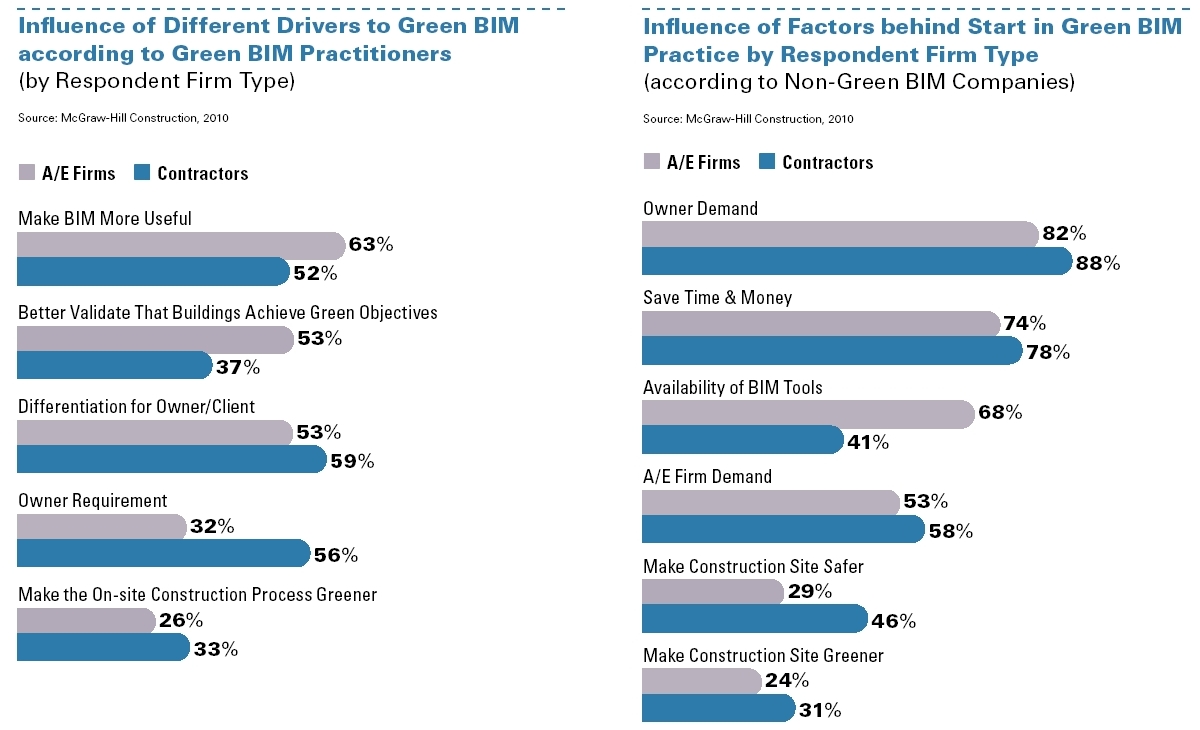 Green BIM-ers already use BIM to improve green outcomes of the design build process. These folks were asked what it would take to increase use of BIM to achieve improved green outcomes. The chart on the left shows their responses.
The Non-Green BIM-ers were asked what it would take for them to adopt Green BIM. The chart on the right shows their responses.
The #1 reason for Non-Green BIMers to use green BIM is “the owner tells me to.” The #2 motivator is “saving time and money.” Green BIM-ers don’t even mention saving time and money when listing what will motivate more of their peers to adopt Green BIM.
These attitudes are consistent with long-term studies of green attitudes among consumers. See my post on the American Values Survey. It found that saving money is the main criteria for buying decisions among non-greens. For greenies cost is no object.
It’s still true: sell savings to sell green
Conclusion: Cleantech marketing lessons of the Tale of Two Priuses
June 18, 2010 — Geoff Foulds In the US the Cash for Clunkers program defines the other half of this Tale.
The US government program paid people cash to trade in their old clunkers for new models. In theory the new models were to be more fuel efficient too – although even the Hummer H2 made the list of eligible replacements.
Despite the rebate the Prius still cost more to own than other midsize cars. During the program Prius sales increased a little but it didn’t make the Top 10 most popular Clunker Replacements list. Neither did the H2.
In Strategies for the Green Economy, Cara Pike writes that the American Values Survey has tracked a steady decline of US interest in ecology values and a rise in fears about the economy, health care and security. These US trends are the opposite of values trends in other developed countries.
That back story played out in the Tale of Two Priuses.
So, cleantech companies face tough choices in the US. Going to market with a price premium attracts Idealists and Greenest Americans. But these segments may be too small for a product to achieve the economies of scale needed to lower prices and win in the mass market.
Or, cleantech companies can lobby to increase the prices of consumables like gasoline, electricity and water. Then the superior efficiency of their products delivers the lowest total cost of ownership. Or cleantech products can be launched without a price premium. So products enjoy a total cost of ownership advantage from Day 1. It’s a strategy that bets on rapid and seamless transition from Early Adopters to the mass market.
Lessons for cleantech marketers in the Tale of Two Priuses
June 16, 2010 — Geoff Foulds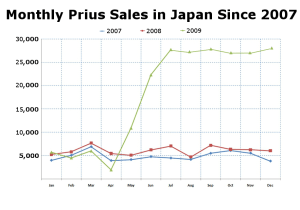
You don’t see change like this often.
AfterToyota’s Prius has carved out a niche in markets and stayed there, except one. In Japan, after years of modest sales, Prius leapt to the top of the sales charts in a single bound. What does the Tale of Two Priuses mean for cleantech marketers?
In all markets Toyota priced its Prius at a premium to cars in its category. Prius offered the highest gas mileage and lowest CO2 emissions. Innovators and Early Adopters have shown time and again that they will pay for performance. The early movers ramp up production which brings down costs. Then prices can be lowered to tap the price-sensitive majority without harming margins.
Of course Toyota faced some complications. It would be awkward if the low-margin Prius took share from its own higher-margin Camry. Or production costs were higher than expected so sales in the niche market failed to reach the economies of scale needed to cut prices.
Whatever the factors Toyota left the price premium on the Prius. Sales stagnated until the Japanese government reduced taxes on the most fuel-efficient cars in May 2009, and the price of gasoline ticked up. Prius became a top performer in total cost of ownership. The sales chart shows what happened. Prius became the best-selling car in Japan.
(next: What happened in the US, and what it means for cleantech product positioning and pricing)
Public policy survey a useful guide for Cleantech marketing
June 15, 2010 — Geoff FouldsThe Guide to the American Values Survey should be required reading for cleantech marketers.
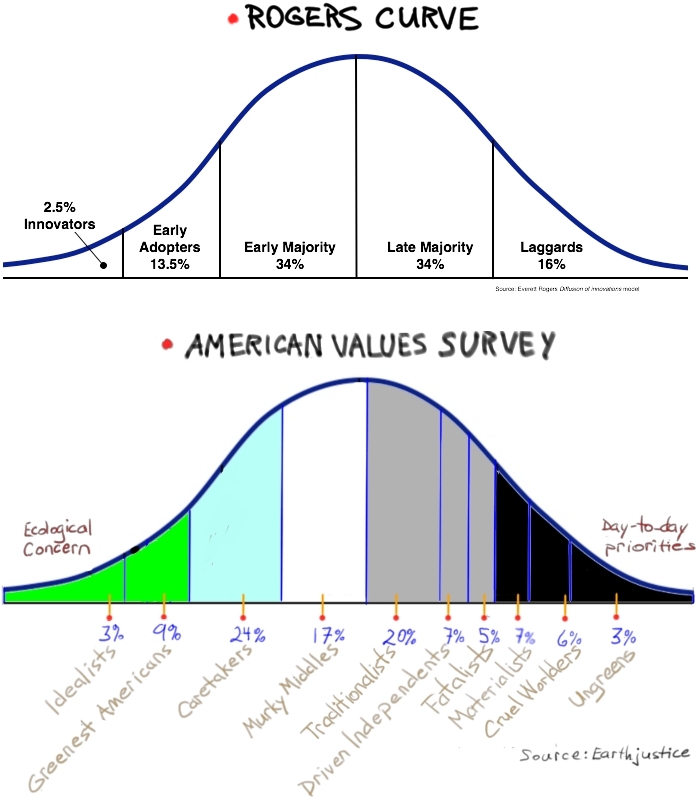
Looking at green values through the Rogers Curve lense shows potential pricing and positioning pitfalls for cleantech products.
The Survey is a public policy tool. But a little reordering of the Survey segments to align with Rogers Curve segments makes the Survey an outstanding resource for cleantech product positioning and pricing.
The values of Rogers’ Innovators and Early Adopters align well with the Values Survey’s Idealists and Greenest Americans, shown in dark green.
Innovators and Early Adopters are the segments where new products should get traction and the Values Survey points to a problem. Idealists and Greenest Americans only make up 12% of the population. Innovators and Early Adopters are usually over 15% of a population.
The segment next in line for product diffusion is Caretakers, shown in pale green. The Values Survey includes Caretakers among the greenies but marketers should not. Caretakers only lean toward green as long as it doesn’t cost extra. For example you will get no marketing value from lower carbon emissions – only energy savings that pay for themselves.
Next to Caretakers are the Murky Middles. Their opinions about “green-ness” are whatever the strongest opinions around them are.
And segments beyond – the Traditionalists and segments further along the curve, shown in grey and black – are very price sensitive about going green. And in many cases they are very vocal.
So, the conventional wisdom of launching new tech-based products with premium pricing can be a trap for new cleantech products. It can doom them to marginally-profitable niche markets – at best.
 Megawatts & Negawatts