To start an argument say “Cash for Clunkers is a good/bad program because…” Take the “good” position to enrage climate change skeptics. Take the “bad” position to get the goat of the eco friendly.
While there is plenty of commentary on the economic impact of Cash for Clunkers, much less is written about its impact on the carbon footprint. That is, how much CO2 do the newly purchased cars and SUVs produce compared to the clunkers traded in?
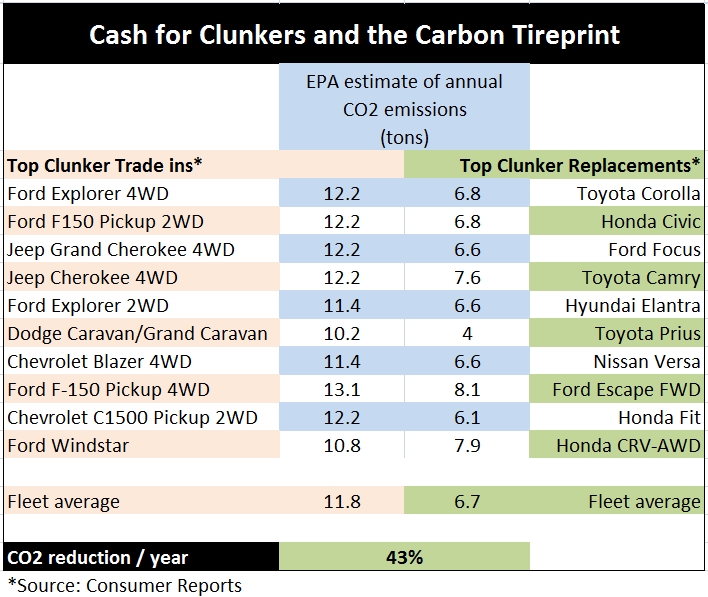
The table below shows the results of my unscientific study of this question.
Non-combustible CO2 is fuel for good arguments.
The top 10 clunker trade-ins are shown in the left-hand column and the top 10 vehicles purchased are shown in the right-hand column. This data is published by Consumer Reports on its web site.
The two middle columns show the CO2 each model produces in tons per year. This data is from the Environmental Protection Agency estimates on its web site. Some trade-in clunkers are so old that the EPA web site doesn’t list them. For those vehicles I used data on whatever the closest equivalent model is.
Then I averaged the CO2 output per vehicle for the clunker fleet, and the replacement fleet.
Based on this data, the average clunker replacement produces 43% less CO2.
Your mileage may vary.
 Megawatts & Negawatts